Key Takeaways
How Does vPAC Reshape Substation Design and Grid Maintenance?
- Hardware-Software Decoupled Virtualization: Virtual Protection, Automation, and Control (vPAC) technology virtualizes protection functions, transitioning power grid substations from proprietary hardware to centralized software.
- Automated Failover Operational Resilience: Clustering virtualized Intelligent Electronic Devices (IEDs) lets workloads migrate automatically to healthy nodes after a failure, sustaining protection functions through self-healing recovery.
- IEC 61850-3 Rugged Host Execution: Running substation software on fanless industrial computers designed to IEC 61850-3 standards ensures stable execution under severe electromagnetic noise.
While virtualization is the cornerstone of software-defined substations (SDS), their true success in remote, high-EMI, and extreme-temperature environments depends on more than just the software. As protection, automation, and control (PAC) functions transition from physical hardware to virtualized workloads, the ability to maintain predictability and uninterrupted behavior even under harsh operating conditions is a critical benchmark. The core challenge for SDS as PAC functions become software based is how to evolve the reliability model from standalone devices to build resilience at the system level. Introducing the clustering architecture for vPAC brings with it a much needed boost of IT-grade high-availability to redefine operational logic for reliability and accountability for the power sector.
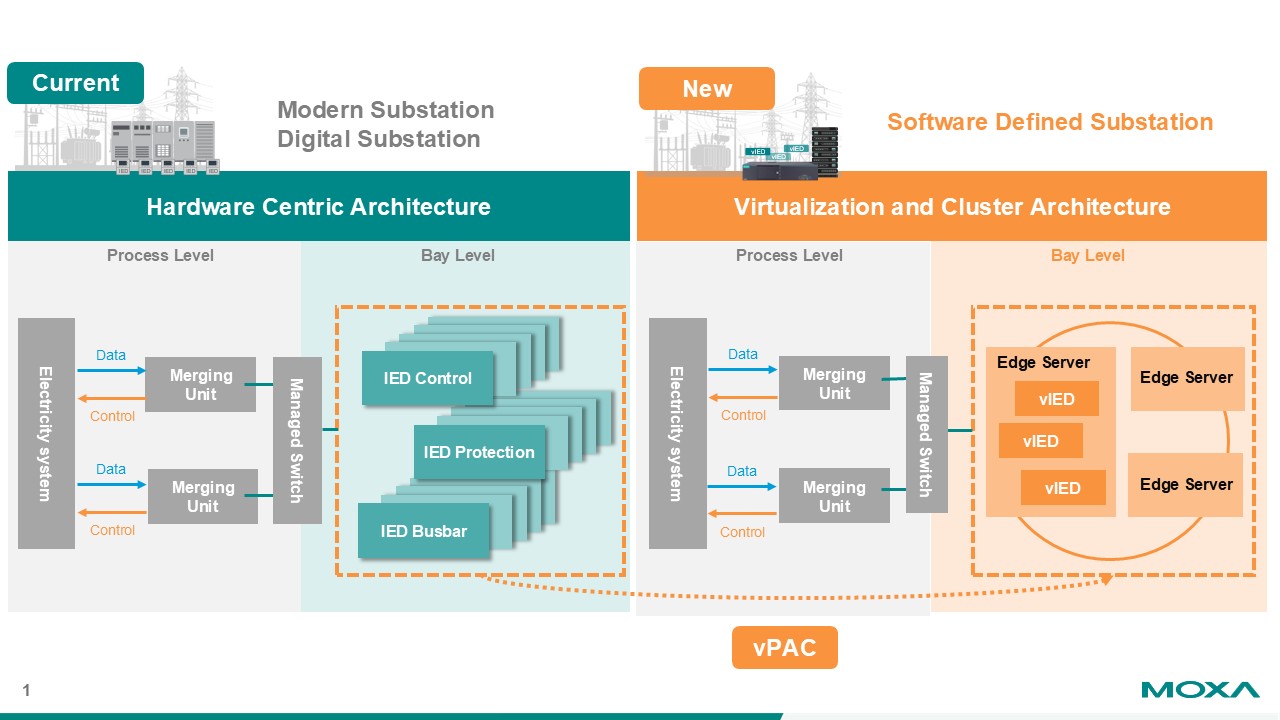
A Paradigm Shift in Reliability: From Device-centric to System-centric
Traditional substation design centers around physical IEDs, built on the power industry's long-standing mandate for ruggedized devices. While this model offers proven stability, it struggles to keep pace with the demands of modern digital substations, especially in these two key areas:
- Time-consuming Upgrades and Maintenance: Because functional logic is still linked to proprietary hardware, even routine security patching becomes a complex task requiring exhaustive downtime planning for unit-by-unit maintenance.
- Fragility of 1:1 Redundancy: Traditional dual-machine hot standby protection relies on a one-to-one independent design. If a unit fails, the remaining units become points of failure with no lateral support from other assets during the repair window.
To overcome legacy system constraints, vPAC reimagines reliability at the system platform level and is driven by the following three core architectural principles:
- Hardware-software Disaggregation: By decoupling protection logic from physical hardware and encapsulating it as virtualized workloads, utilities gain the flexibility to deploy functions across standardized server platforms based on actual grid needs.
- Automated Failover and Self-healing: By grouping servers into clusters, the platform ensures that if a single node fails, the system automatically migrates workloads to healthy nodes, ensuring uninterrupted protection and resilience through the self-healing process.
- Operational Continuity: vPAC transforms the maintenance mindset from a stability through stagnation approach to controlled continuous evolution. Hardware maintenance and security updates can now be completed seamlessly, ensuring service continuity without interrupting power operations.
Operational Benefits Comparison
|
O&M Dimension
|
Traditional IED (Device-centric)
|
vPAC Platform (System-centric)
|
|
Remote Management
|
Relies on on-site diagnostics; requires manual per-unit operation
|
Remote monitoring and recovery via out-of-band management (e.g., BMC/IPMI)
|
|
Update Resilience
|
Complex processes, updates often cause service interruptions
|
Seamless upgrades via bulk software deployment and clustering mechanisms
|
|
Spare Parts Strategy
|
Requires stocking various specialized models and brands
|
Shift toward standardized substation-grade server nodes, simplifying procurement
|
|
Life Cycle
|
Upgrading usually requires total hardware replacement
|
Smooth hardware evolution by adding nodes and migrating workloads
|
The focus shift from individual devices to system-centric platforms is driving a digital transformation in the energy sector. To accelerate the journey from concepts to actual field validation, global cross-industry collaborations have been forged. Leading initiatives, such as LF Energy’s SEAPATH project and the vPAC Alliance, are actively dedicating resources to refine and standardize the new architecture.Through these pioneering efforts, the power industry is finding ways to break through the physical constraints of the substation environment. This has led to the development of hardware benchmarks like the L2 Profile—a reliability-first specification. The L2 profile ensures that once virtualization is deployed, even in unmanned sites where maintenance is highly challenging, it strikes the optimal balance between high performance and field survivability.
Engineering for Unmanned Sites: Why the L2 Profile is a Strategic Choice
In unmanned substation environments, operational expenditure (OPEX) is heavily dictated by the logistical burden of truck rolls—the recurring cost of dispatching technical personnel to remote locations. To mitigate these costs, the vPAC Alliance has developed tailored hardware profiles. The L2 Profile, in particular, serves as the operational benchmark for high availability by directly neutralizing the engineering pain points of remote sites.
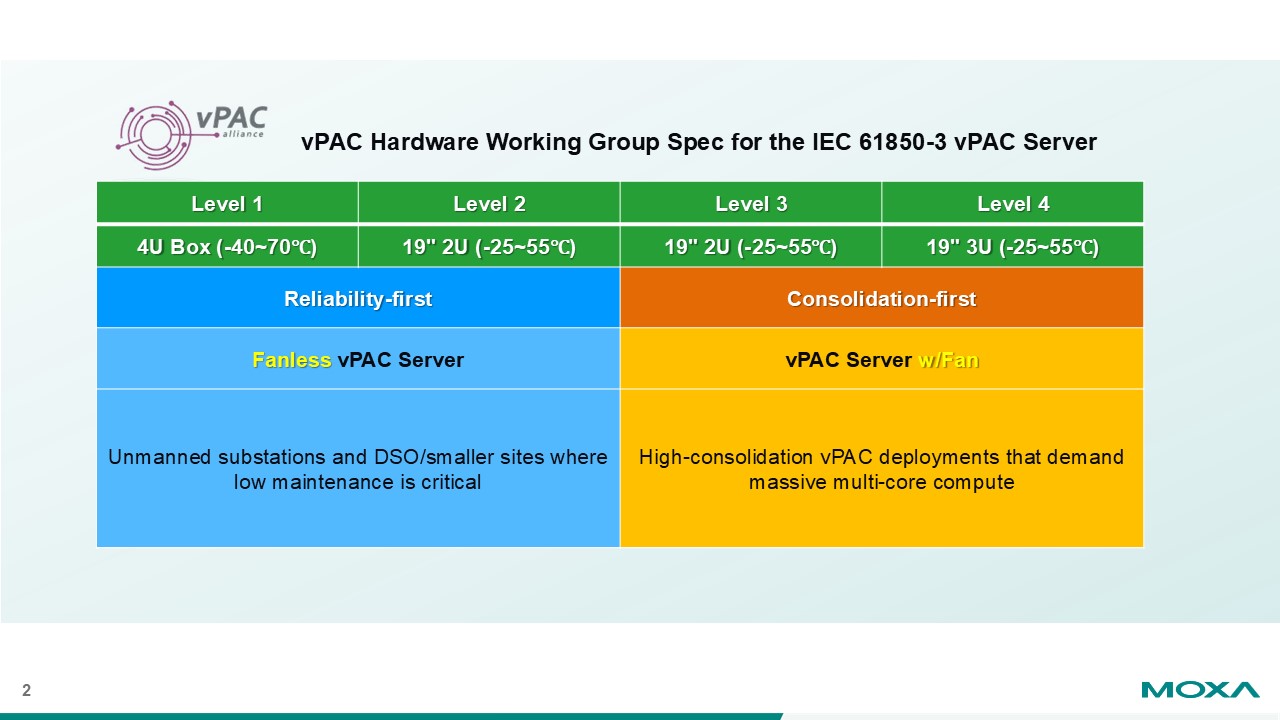
- Zero Moving Parts to Mitigate Mechanical Risks: In remote sites where maintenance is impractical, fans and filters are notorious failure points. By mandating a fanless architecture, the L2 Profile eliminates these physical vulnerabilities, ensuring predictable, long-term stability and maximizing MTBF.
- Substation-grade Ruggedization: Virtualization host platforms often endure extreme thermal cycling and intense EMI. Strict compliance with IEC 61850-3 and IEEE 1613 requirements ensures a hardened platform rather than a potential point of failure.
- The Golden Balance of Performance and Availability: While higher-tier profiles offer greater computing power, they often require active cooling—a liability for unmanned sites. The L2 Profile represents an engineering sweet spot, delivering robust virtualization performance while strictly adhering to a low-maintenance mandate.
The Path Toward SDS: Balancing Performance and Field Survivability
As PAC systems shift toward a software-defined architecture, grid competitiveness is no longer measured solely by raw computing power. Success now hinges on platform sustainability—the ability to maintain operations remotely and evolve the system without disruption. This essentially is the pursuit of the optimal balance between digital performance and field survivability. This shift to software-defined architecture calls for a critical reflection on the engineering fields as businesses implement advanced virtualization. How must the underlying hardware adapt to the harsh physical constraints of a substation? For unmanned sites prioritizing reliability, the fundamental design trade-offs—particularly regarding environmental and thermal resilience—are what allow the software-defined substations (SDS) to move beyond theory and achieve robust, real-world validation.